Art, Architecture and Memory: Insights from Good Hope, Jamaica
Ke Vaughn Harding hails from Falmouth, Jamaica, a late 18th century port town with a distinctive architectural character that inspired his love for design and historic preservation. These interests led to his involvement in the preservation of Falmouth’s historic architecture through an initiative that rehabilitated vernacular cottages to provide improved housing for local residents. He now works with our Santa Fe office and brings to his projects an interest in historic preservation strategies that balance new occupant needs with the retention of cultural legacies – a parity that has been of critical importance to our ongoing Owe’neh Bupingeh rehabilitation project, with which he is currently involved.
The value of historic preservation is often defined by its role in preserving a community's collective memory. This memory, in principle, fosters the sense of shared identity and belonging that is vital to thriving societies. Places of memory are, however, often complex – sometimes representing contentious pasts and contested identities. If they are to fulfill their roles in perpetuating a true sense of identity and belonging within communities, the preservation of memory requires holistic approaches to its execution. Not only must these strategies directly address difficult pasts, but also play a role in remediating contentious places to a state of habitability for current and future users.
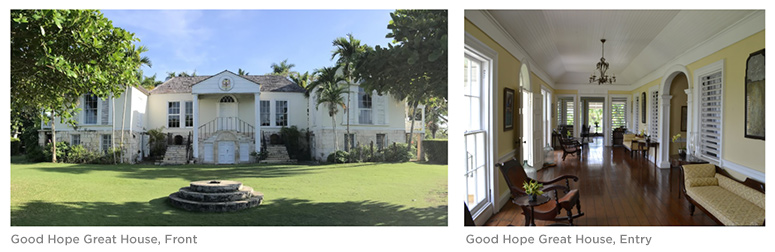
Good Hope Estate is one of many places in Jamaica where built heritage is intrinsically tied to a long history of extracting forced labor through the inhumane institution of slavery. Here, the ongoing historic preservation work contends with a process in which the retention of historic fabric must be inextricably linked to the restoration of livability in the wake of a difficult past. Recent archaeological and documentary research have begun to provide greater insight into the domestic lives of the enslaved community that lived and toiled there. During these studies, art and architecture were employed in the processes of reimagining and recreating the largely vanished contexts of these peoples’ lives.
Historical Context
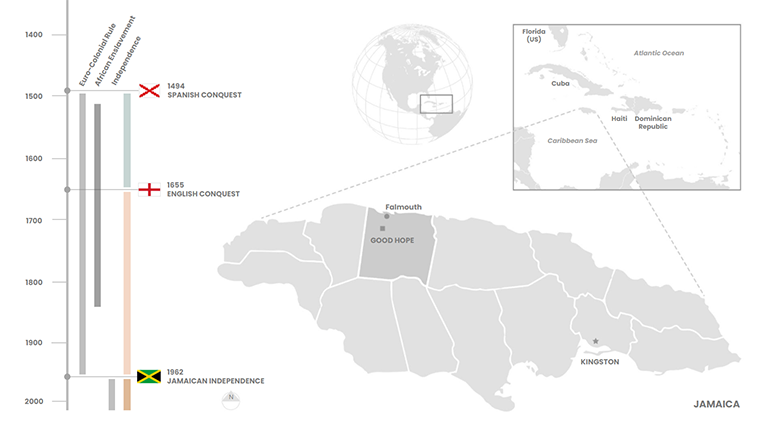
The island nation of Jamaica is a microcosm of the complexities that accompany historic sites across the Caribbean. It is also emblematic of the historic preservation strategies that may be harnessed in the processes of confronting painful pasts head-on. Most Jamaicans are the descendants of enslaved Africans, and the people co-inhabit the island space with the specters of a grueling colonial history. Since the more than 500 years after the first forced arrival of captured Africans on the island, the Afro-Jamaican population has only experienced roughly 60 years of independence from colonial rule.
The result of this lengthy and oppressive history is that the everyday built environment is thoroughly intertwined with the physical remnants of its disturbing past. The sheer volume and extent of this built heritage makes it neither useful nor possible to simply ignore or erase. Despite this, a self-governing Jamaica not only occupies, but commandeers its space instead of being haunted by it. To be haunted, in this specific context, suggests a passive position on the part of the living. Instead, the Jamaican tradition enables the active pursuit of the country’s ghosts, recognizing the transformative power of appropriating space through the truth-telling of its peoples’ lived experiences. In this tradition, the resetting of livability is achieved through speaking the truths of hardship, but also the triumph over it. This is the context through which the Good Hope project is best understood.
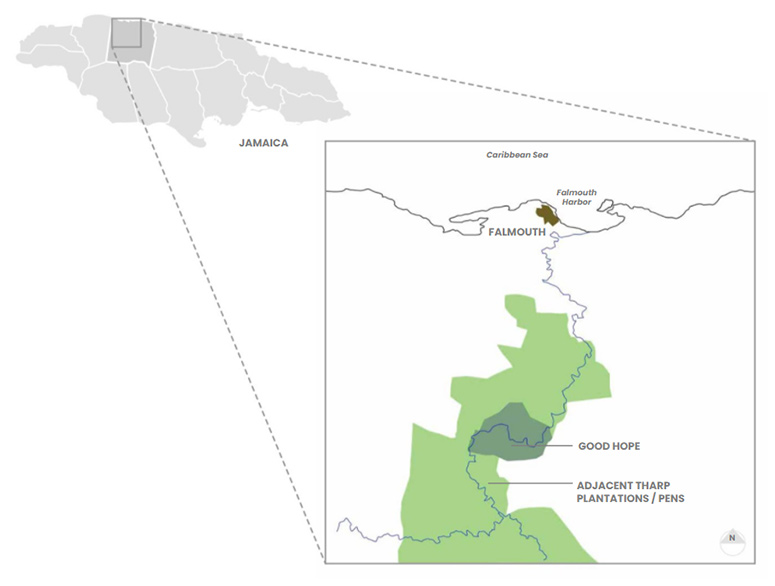
After John Tharp’s purchase of the plantation in 1767, Good Hope grew to become the center of his sprawling sugar empire. This estate was both rural and urban, and stretched across two parishes. By the time of Tharp’s death in 1804, his vast industry rode on the backs of close to 3,000 enslaved people. Across Tharp’s former empire, his built legacy speaks to the scale of his ill-gotten wealth. His multiple plantation houses, sugar factories, wharf, aqueducts and other infrastructure portray a sophisticated understanding of the value of complex civil engineering, and of climate-responsive design.
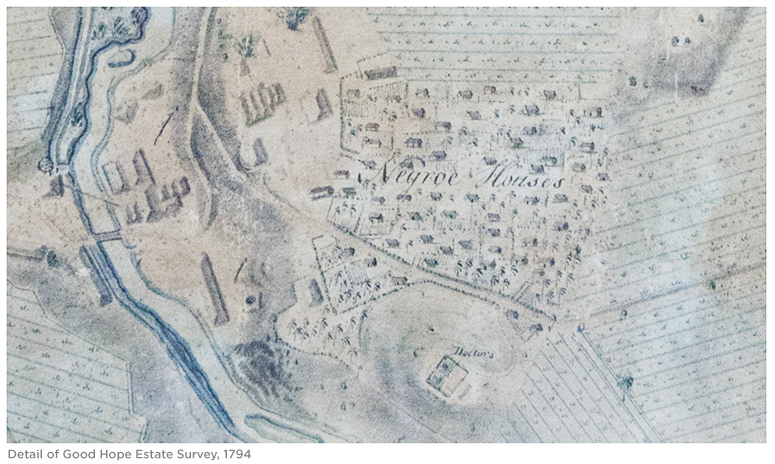
By contrast, those that Tharp enslaved, along with their stolen bodies and stolen futures, were also deprived of much of the agency that typically allows people to secure their own memory through long standing built works. A detail of a 1794 Good Hope survey shows the main village of enslaved people located near the heart of the plantation’s factory complex. This location prioritized the estate’s operational efficiency while eroding the inhabitants’ agency through constant surveillance by plantation administrators. Still, their memory speaks through the dispersed and dissolved remnants of their own, more perishable constructed environments at the village site.
Archaeological Investigation
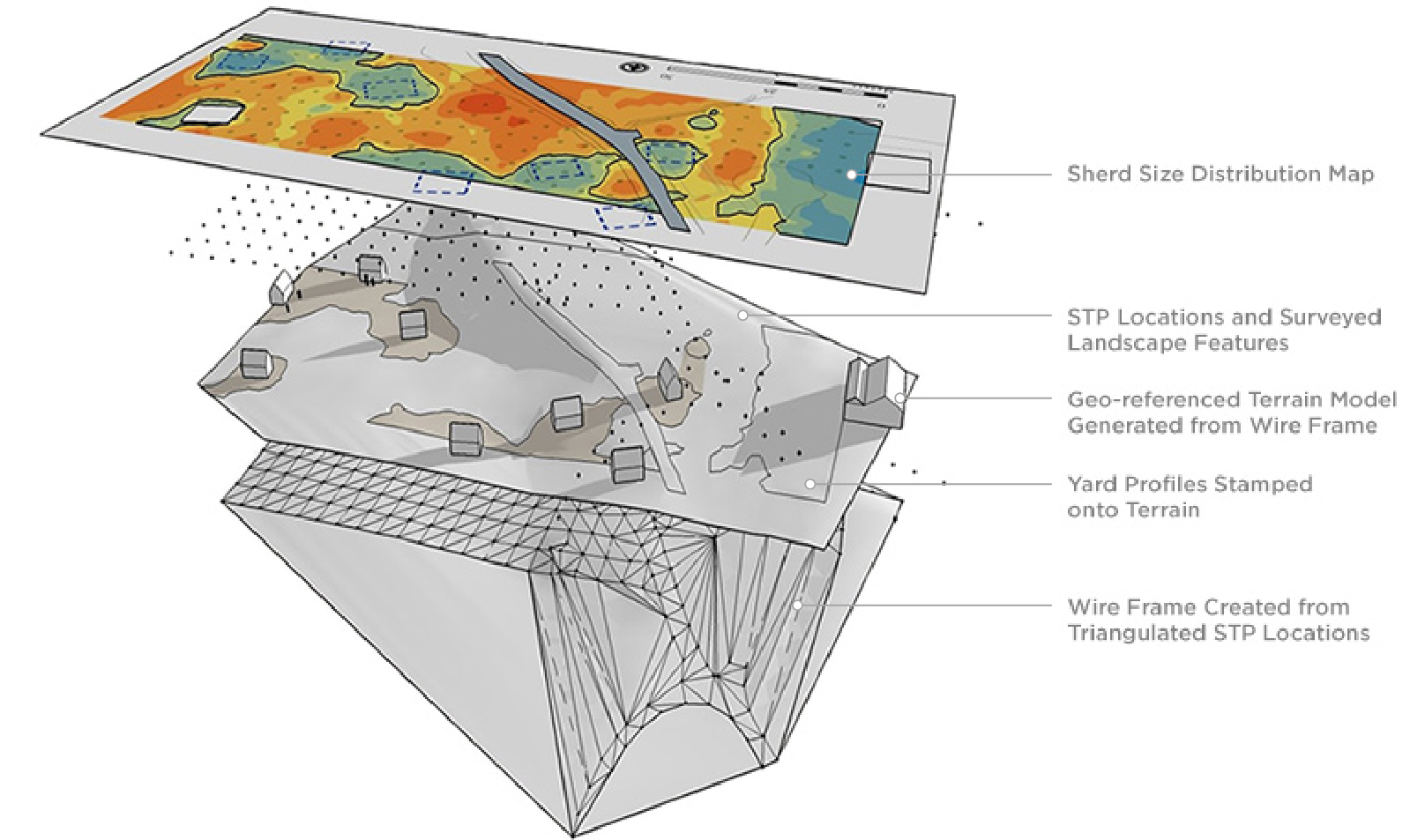
In pursuit of the artifacts of this community’s humanity, archaeologists established a grid of shovel test pits across a portion of the former plantation during the summer of 2014. What the archaeological dig extracted was the imprints of lost souls. Activities, routines, and lives were conjured in the form of not only ruined building foundations, but also evidence of swept yards, garden walls and objects representing daily life.
Physical vestiges gave clues to the nature of lost building envelopes. Examples include the extensive collections of sizable nails at house sites, which suggested the predominant use of a nailable wall cladding. Conversely, the absence of surviving roofing fabric intimated the use of materials that readily disappear without leaving an archaeological record. Thatch — the use of which was well-documented at similar village sites in enslaved communities — is a roofing system that fits this material profile. In a bid to produce informed interpretations of the architectural discoveries, historical sketches and text descriptions of similar sites were interrogated for parallels to the Good Hope site.
Art and Architecture as Storytelling
From the archaeological findings, a low resolution digital reproduction of the lost landscape was generated. While useful for examining the study area at the macro scale, that model was not particularly effective at exploring or communicating the ultimate project objective — that of interrogating the true texture of resourcefulness and materiality of resilience. For this reason, traditional hand sketches were chosen as a more evocative medium through which these distant, inherited memories would be conveyed.
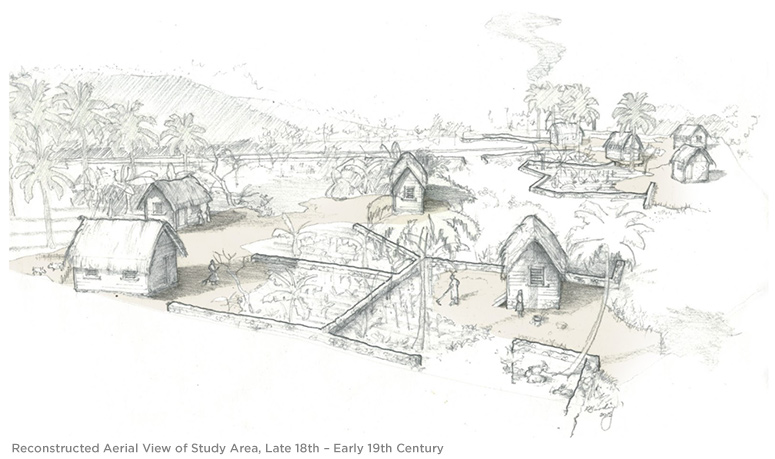
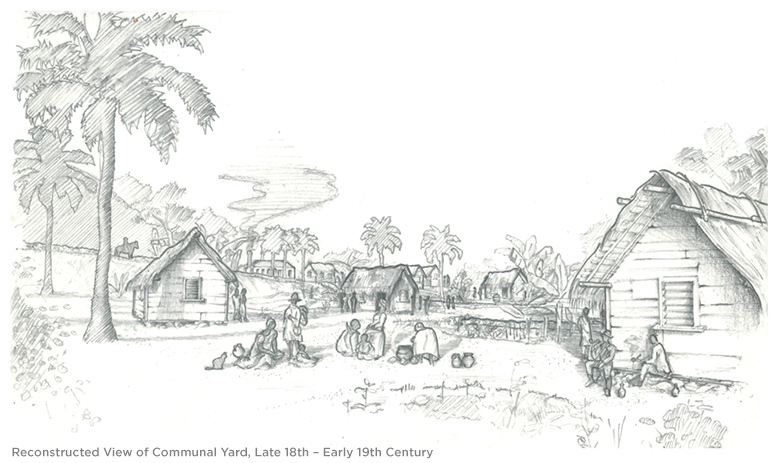
A reconstructed aerial view was used to provide an overview of the study area. While it is largely illustrative of architectural expression, it also introduced ideas about the act of occupying space itself. Subdivided yards suggested well-articulated outdoor use patterns, with cultivated grounds and outdoor cooking areas possibly occupying distinct zones within the yard. Drawings also expressed ruminations on unanswered questions. Houses clustered around a communal yard, for example, raised questions about the nature of kinship in a community where families could have been easily fractured by the sale of human beings.
In an effort to further emphasize the humanity in the lived experiences associated with the site, other examinations of historical records focussed on depicting the enslaved inhabitants of these spaces. Research also served to inform the depiction of archaeological objects, and the unearthed memory of interactions between these objects and the souls that once shaped and used them. The product was a series of windows into the resulting interpretation of the domestic lives of Good Hope’s enslaved people. Here, for example, yard spaces could be properly depicted as places of fortitude and resilience — as spaces that housed efforts towards self-sustenance, in spite of the state of forced labor in service to John Tharp.
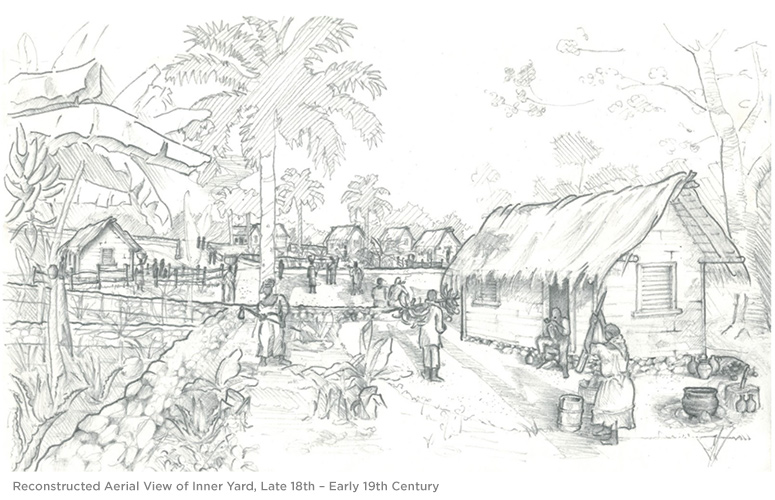
Some scenes explore the overlapping of plantation occupations such as farriering and blacksmithing with the village site, an example of the perpetual intrusions of forced work into the enslaved peoples’ daily lives.
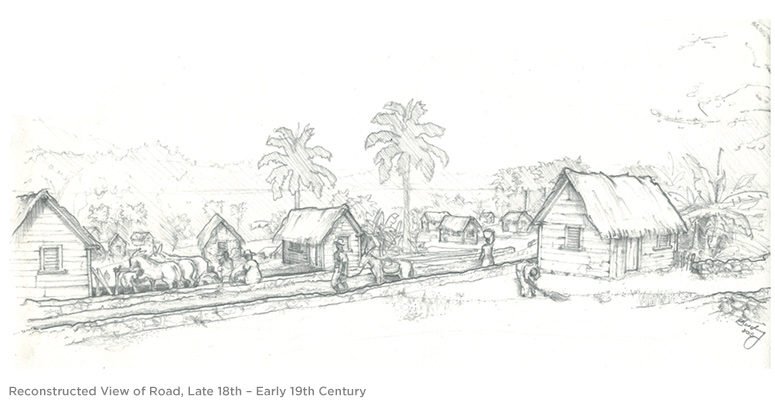
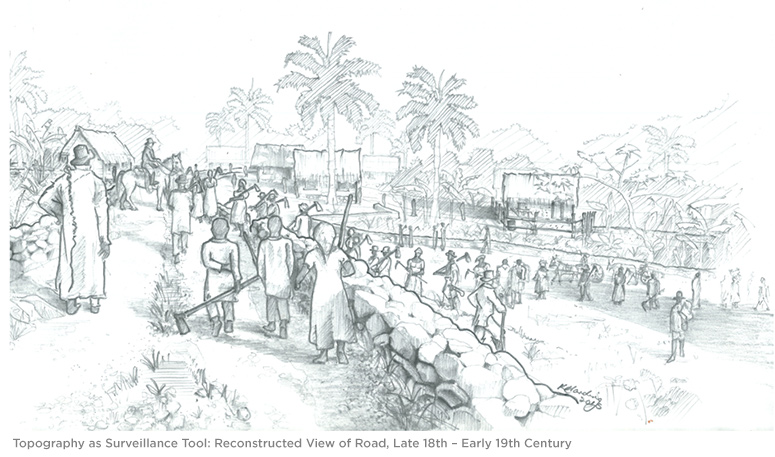
Other scenes imagine the nature of communal outdoor living, as well the implications of topography on the lives of the village inhabitants. Situated within a depression in the landscape, bounded by an elevated main roadway, the village location would have given plantation authorities sweeping views of the people they oppressed.
Some scenes further explore the possible uses of topography extending beyond surveillance into the very acts of regimenting forced labor.
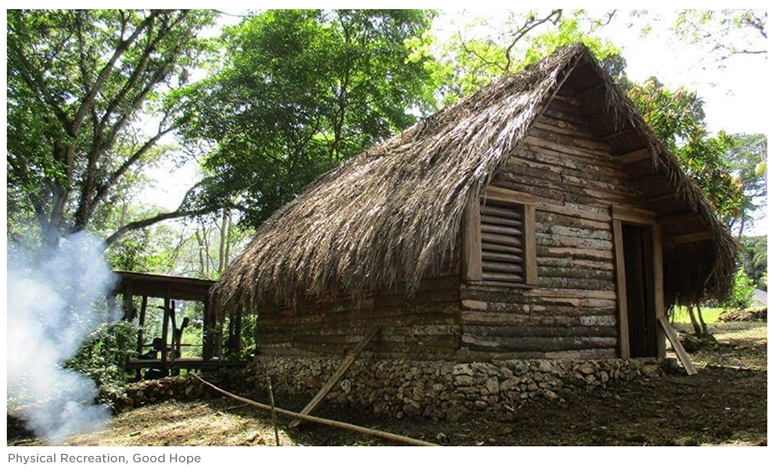
These acts of truth-telling culminated in the physical occupation of space through the partial recreation of this largely lost, but vocal landscape. The recreation is devoid of costumed docents and overbearing interpretive material — a result of an ongoing examination of the manner in which the site may be most effectively expounded upon. The ultimate objective is that the site will be subtly and reverently shaped to facilitate quiet contemplation and reflection, and consider not only the challenges that Jamaicans have faced, but also the vehement victory over these hardships that the country rightly chooses to celebrate.