
Sustainability
We believe that sustainable design is good design. Better buildings benefit the planet, improve the wellness and prosperity of their users and owners, and sustain communities and cultural traditions.
Atkin Olshin Schade Architects recognizes that building construction and operations are responsible for roughly 40% of annual global greenhouse gas emissions that cause climate change. As a member of the US Green Building Council and an AIA 2030 Commitment signatory firm, we are committed to designing for energy efficiency, reduced carbon emissions, and increased resilience in all projects, with a goal to achieve carbon neutral buildings, developments, and major renovations within the next decade.
Read our 2020-30 Sustainability Action Plan to learn more about how we design for increased resiliency in a changing environment.
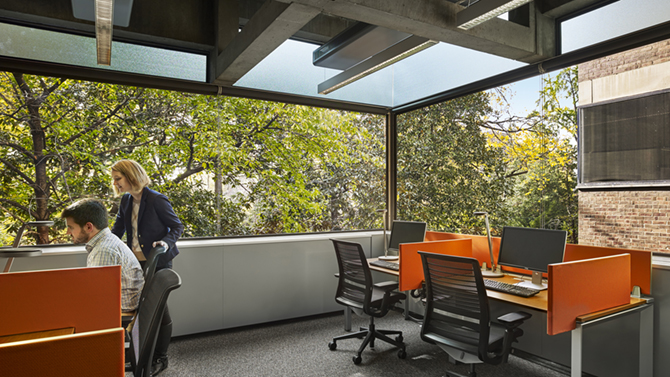
Sustainable Preservation and ReuseHigh-performance glazing and mechanical systems combined with newly programmed uses requiring fewer air changes have greatly reduced energy usage and given new life to the Richards Medical Research Laboratory, one of Louis Kahn’s icons of modern architecture and a National Historic Landmark.
Guiding strategies
We promote the preservation and adaptive reuse of existing buildings and urban sites to avoid much of the embodied carbon emissions of equivalent new construction and reduce lifetime transportation emissions associated with the development of new sites.
We strive to create high-performance, energy efficient new buildings and major renovations that prioritize occupant comfort and wellbeing, while delivering lasting value to owners through dramatically reduced operational costs.
By utilizing low-impact materials and methods of construction, we design durable, versatile buildings that adapt to inevitable climatic and programmatic change and support local and regional knowledge, economies, and communities for generations to come.
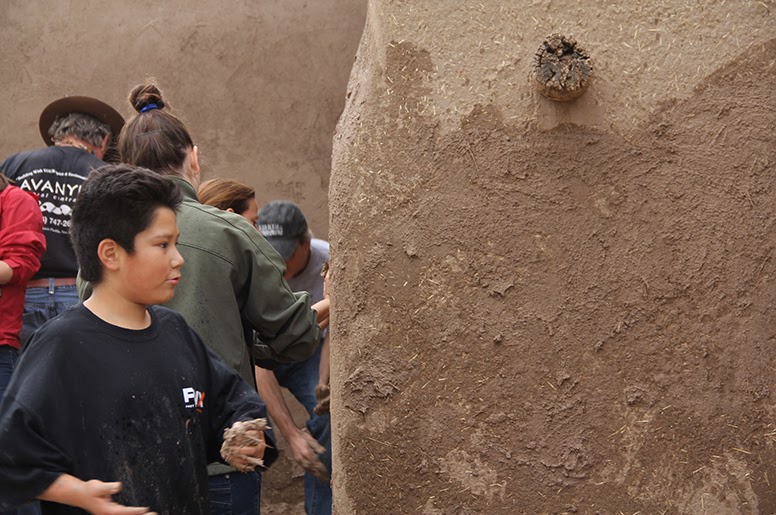
Resilient Planning and DesignNew and renovated homes in the Ohkay Owingeh Pueblo incorporate locally sourced materials and traditional construction techniques like adobe and mud plaster, supporting local labor and strengthening settlement patterns and cultural activities that are centuries old.
Holistic, data-driven, and integrated process
We begin projects by establishing ambitious energy use and embodied carbon targets, and engaging all project stakeholders in a collaborative design process.
Low- and no-cost design and construction conservation strategies are pursued first. This includes minimizing the use of carbon-intensive steel and concrete in new construction and incorporating passive design strategies, like building form and orientation, thermal envelope, daylighting, solar shading, and natural ventilation.
We integrate energy efficient, fossil-fuel-free building systems and advanced controls, and healthy, renewable, and low-carbon building materials. Remaining energy demands and embodied carbon can be further offset by on- or off-site renewable energy procurement, as well as carbon-sequestering site and landscape design strategies.
Throughout the project delivery process, we engage in iterative energy and carbon modeling, tracking, and verification to understand the impact of our design decisions and assess progress toward stated project targets.
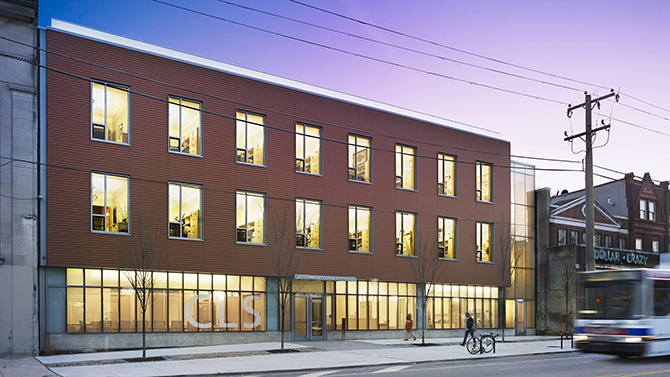
High Performance New BuildingsThe courtyard at the North Philadelphia Law Center provides all spaces with access to controlled daylighting and natural ventilation, minimizing the building’s reliance on artificial light and mechanical cooling.
Metrics
AOS Architects has designed projects to meet green building standards and certifications, including LEED for Building Design and Construction, Enterprise Green Communities, Passive House, WELL, and Living Building Challenge.
